Saturday, May 30, 2009

Part II (of III)

Sarah: To continue...here's Part II.

The last couple weeks of the semester flew by, with the students taking every opportunity to go on a hike, watch a movie together, or play a game. During the last academic week they were all busy finishing papers, collecting data for their research projects, and preparing for their community presentations. At the end of the last academic week, the very end of April, the final SNU professor came down, Bob Lively. He didn't come down to teach, but to be a part of the wrap-up and debriefing process and to observe the community presentations. It's always fun having Bob around, especially since his sole commitment is to evaluate the program and talk to students about their experiences.

Commuinty presentation night is always a highly anticipated night by both us at QERC, and also by the community. Unfortunately, the weekend we had laid aside for presenting the students' research turned out to be a busy weekend for the Chacon family, who is often most of our crowd. One night there was a soccer game in an adjacent valley, so many family members were going to be gone for that night. We scheduled the presentation night for Friday in hopes of gathering as many people as we could, but that day also proved to be an unexpected day for the Chacons. It was the day that many family members came to visit with the purpose of hiking the trail from San Gerardo over to Providenciea with Efrain Chacon (the grandfather and patriarch of the family) in order to re-walk the steps Efrain took when he first came over here in the early 1950s. I think they may have underestimated how exhausted they would be after the trek, and all ended up falling asleep by the time our presentations were to begin!

Needless to say, we had a very great turn out, with about 40-50 people in attendance. Many people hadn't been to QERC before, and we enjoyed hosting them and showing them around our building. Our students did a fantastic job presenting their research, with Raul Fernandez (grandson of Efrain) doing our interpreting. It's always a fun night to see everything finally come together, and the students also were relieved to have the final academic component complete! As a celebration we had a sleepover with popcorn and a movie and leftover cookies from the presentation night.

Once presentation night was over, the students only had one last weekend here at QERC and in San Gerardo de Dota. Much of their time was spent packing and saying goodbyes to friends in the community, but they also had to get in many last card games and hanging out with each other. Some of their friends from the community came over for one last night of playing "sardines" outside and Mafia inside when they'd had enough running around. After a good last weekend with little sleep, Monday morning rolled around and the final goodbyes were said to this place.

We had scheduled a few days at the end of the semester for a debriefing/re-entry retreat with our students, and like last year, this took place up at Arenal Volcano. This year we stayed at the Arenal Observatory Lodge, the closest lodge located near the volcano. We had beautiful views of the smoke coming out of the top of the volcano and rocks tumbling down the side. It's also a great location for watching some beautiful birds and swimming in their pool and Jacuzzi while watching the volcano. One afternoon we took advantage of some of the attractions around the area and did the Arenal Hanging Bridges. We had a great time exploring and going on one last hike together, while being able to cross 6 bridges suspended up in the canopy. It put us right at eye level with some beautiful birds and made for some terrifying views (for me!) of the land far below us.

Though our time at Arenal may sound like it was all play and no purpose, that was not the case. We had scheduled 4 different "sessions" where we had lively discussions both in order to debrief the entire semester, and also to prepare the students for re-entering their home country and culture. It was a good time of recapping all of their memories, and pulling out the more meaningful experiences and worldviews that they wanted to bring back to the U.S. and implement in their lives back home. We also discussed reverse culture shock in full detail, complete with fun skits where the students tried to imagine what their lives would be like upon their return.

After Arenal, we returned to San Jose for one last night together, complete with a movie at the VIP theater where we saw a movie sitting in our own personal recliner chairs, and a nice dinner to finish. And then it was time to say our goodbyes at the airport the next morning, not only to our students, but also to Peter, who had been our intern for almost 7 months and an integral part of the semester program. They will all be missed!

To be continued with Part III...

Tuesday, May 26, 2009

Part I (of III)

Sarah: Well it’s been forever since we’ve written a blog entry. David has been excited to write about the second half of TES, but our lives very quickly became very busy, and he was never able to get to it in the midst of everything else. I’ve decided to catch up our blog on everything SINCE that class finished, and I’ll let David go back and write about the second half when he has a chance.
So I’ve decided to split up this enormous blog entry into three parts, in order to cover everything between the beginning of April and now, and not to overwhelm any faithful readers in the process.
Thus begins Part I.

After TES, our group returned exhausted but thrilled with their experiences traveling around Costa Rica. After learning all about the different ecosystems in Costa Rica and experiencing firsthand different sustainability projects, it led well into the next professor coming down for classes. Marty Michaelson came down to teach his week of Biblical Theology in Global Stewardship, so it gave the students even more of a chance to approach the topic of stewardship in their personal lives and from a biblical perspective. After TES and Global Stew, our students were feeling quite motivated to go back and change the world, recycling one tin can at a time. :)

Following Marty’s week, the students had a full schedule. Three professors came down, Nancy Halliday, Carrie Bentley, and Sharon Young for her second time. Sharon continued to work with the students a little bit with the Entomology class, and Nancy was down to teach Tropical Medicine. Carrie is a new professor at SNU, so she came along to check out the location and the semester program. She also has a lot of experience with research, so she took the opportunity to sit down with each student and talk about the direction of their research project. Though late in the semester, those talks were valuable and encouraging to the students to finish their research strong.

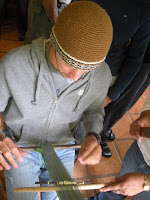
Tropical Medicine was the focus for the week, with the students following the same schedule as with the other visiting professors and having class time every afternoon. However, unlike the other classes, this particular class incorporated a couple of extra elements. David and I had met and briefly gotten to know the chief of the indigenous tribe Boruca here in Costa Rica, so she and 2 other women came to visit and talk with the students about their customs and culture with a focus on how they utilize medicinal plants within their community. The workshops the gave to the students were incredible as they talked about their lifestyles, how they make a living, and the struggles they have as indigenous people being less than 1% of the population of Costa Rica. Toward the end of their workshop they actually did a demonstration of how they weave the cotton into thread and then how they use that thread to make all sorts of artisan goods like bags, purses, and belts. They are also famous for making Boruca masks, which are elaborately designed and painted in the shapes of animals from Costa Rica. The students took turns weaving, and were excited to purchase lots of handmade souvenirs from these women.

Later that week, the Tropical Medicine course took a field trip into San Jose. First stop was InBio, the Institute of Biodiversity. Here they received a lecture followed by a tour of the bioprospecting unit, which looks at the chemical properties in plants and animals and fungus to be used for medicinal purposes. After that, we headed to Clinica Biblica, one of the main private hospitals in San Jose. They received a talk from QERC’s main doctor, Dr. Longworth, and then a tour of the hospital. Everyone was impressed with the high quality of the equipment and facilities in the hospital.

The following week was the last week of visiting professors for the students. Frank Johnson, the Spanish professor at SNU, came down to finish up his week of teaching Applied Cultural Integration. The students had each done a project of their choice on an issue dealing with Latin America or Spain, and they each gave their presentations to Frank the week he was here. The other purpose for Frank coming down was to give the students a test over their Spanish ability. It wasn’t mandatory, but allowed for the students to possibly get credit for Spanish in addition to the other 15-17 credits they were receiving in other areas. Almost all students received at least 6 Spanish credits, with two of our students receiving 12 Spanish credits! It is a lot of fun to see them so excited about learning more Spanish, now that they have a desire to learn more and better communicate with Spanish-speakers they’ll come in contact with.

And for the last picture, every weekend our students continued to enjoy the excellent food and good fellowship up at Laura’s bakery. Most of them even bought a hat that they had picked out the colors for and were made by Laura’s Costa Rican sister-in-law.
I’ll leave that to be the end of Part I…

Friday, March 27, 2009

Sea turtles, Jabirus, and Ocelots...oh my!

Sarah: The past few weeks have flown by. John Cossel, herpetologist from Northwest Nazarene University, was here for a week teaching about reptiles and amphibians. After that, Sharon Young from SNU was here to find bugs (not hard) and teach about entomology. This was the third of three weeks that the students had professors here on site to teach Topics in Tropical Montane Forest Ecology (the first being Dennis Seigfried from SNU to teach ornithology). All three weeks were busy and tiring for the students, but also proved to be excellent in getting them excited to learn about the critters in the forest right here around us.

After those three weeks were over began some travel time. Most of our students left on a 4 ½ day Spring Break, in which they traveled over to the Caribbean for some much-needed relaxation and beach time. They chose the Caribbean because they won’t be seeing that area of the country during the rest of the semester, and they had a great time renting bikes, exploring Cahuita National Park, and playing in the ocean.

Right after Spring Break, everyone met up in San Jose to begin the Tropical Ecology and Sustainability (TES) course. I did not meet up with them, and stayed here at QERC to host a couple of researchers from the University of Calgary while the group is out traveling. The first half of TES blew everyone’s expectations out of the water! Our 6 students and David met up with 4 students from the Latin American Studies Program and Trevor, our good friend who is the faculty member representing LASP. In only one week, they toured Earth University, hiked around Tirimbina Rainforest Center, visited Arenal Volcano, hiked around Palo Verde National Park, stopped by Casa del Sol, spent some time in Ostional, and ended up back here at QERC exhausted but on cloud nine.

Earth University is an international school for teaching sustainable development and agricultural techniques for tropical countries. The group took a tour to learn about their approach to academics and training students to return to their home countries in order to be agents of environmental change by solving global issues of poverty through sustainable development. Tirimbina Rainforest Center is a privately owned nature preserve originally purchased by a natural history museum in Madison, WI, and is now operated by Costa Ricans with the purpose of promoting research, education, and habitat preservation. The group experienced the Caribbean lowland rainforest with a local guide sharing about rainforest ecology. David claims that their guide Carla was the best guide he’s ever had in Costa Rica! The students enjoyed seeing some cool birds, poison dart frogs, and bullet ants.

At Arenal, the group studied volcanology up close and personal, and had a chance to visit one of our favorite places, Ecotermales. Hot springs are fairly common around the town of La Fortuna, where Arenal is located, and Ecotermales is a family-run hot springs that practices sustainability and conservation efforts when running their business. After a talk from a family member, our group enjoyed time to soak in the warm, tranquil hot springs. From Arenal the group spent time in Palo Verde National Park to study dry forest ecology. They hiked around a lot, studied wetlands, became enamored by the many birds (including the Jabiru, the largest stork in the world standing 5 feet tall), and hit the jackpot when they came across an ocelot on a night hike! The ocelot lounged on a branch in front of them while they were able to watch for about 15 minutes. The picture here is the only picture one student was able to take before his battery died on his camera.

From Palo Verde the group stopped by Casa del Sol, an NGO focusing on local environmental issues that involve cooking, teaching women how to use solar ovens and encouraging families to lessen their consumption of processed foods and increase their consumption of local, native, seeds and grains. The group ate their lunch prepared by the women who are a part of this operation. After Casa del Sol, everyone headed over to the Pacific coast to Ostional to learn about sea turtles. An unexpected surprise was the fact that there was a researcher there who recruited our group to help out with his research on the turtles. Two nights in a row our students broke up into 2 groups, each having a 6-hour shift patrolling the beach in search of the turtles. Once found, the group measured the turtles, tagged them, counted eggs, inserted temperature recording devices for further data collection, and witnessed the entire egg-laying process. On a few occasions this research involved picking up the turtles or wrestling with them in order to take proper measurements!


Now the group is here at QERC to study cloud forest ecology and hear don Efrain Chacon speak about the history of the valley. I’ve enjoyed time to work on my own projects and have some down time, but I have to admit I’m thrilled to have them back!

Monday, March 02, 2009

Nicaragua and other news...

Sarah: A few weeks ago was the start of an 11-day study trip to Nicaragua that David and I facilitated for our students. This was a very similar trip that we did with last year’s semester program, so if things sound familiar….you’re remembering last year’s blog post. :) We went into San Jose on Sunday so we could hear a guest speaker to kick off the trip. Aminta Ortiz, a Nicaraguan with an incredible life-story, spoke to our group about growing up in Nicaragua and living under one of the Samoza’s leadership. She has a very impacting story and enjoys sharing her life and viewpoints with groups who want to hear. After she spoke, our entire group went over to her house where she cooked us Nicaraguan food and we got to hang out with her son and daughter. This was a treat for me, because this was my host family about a year and a half ago when I was working part-time in San Jose.
Monday we headed off to Nicaragua, and after a long day on the bus and a fairly smooth border-crossing, we arrived to our retreat center in Managua, the capital. We took the students on a tour of the historical sites of Managua, stopping at places like the Revolutionary Plaza where the Sandinistas overthrew the Somoza regime, the old cathedral that was destroyed in an earthquake, and Loma Tiscapa, one of the most famous locations in Managua. It was here that the U.S. Marines trained the National Guard under the Somoza regime, and where Sandino had his last meal before he was captured and assassinated (arguably the most heroic figure in Nicaraguan history). The place is complete with a museum dedicated to Sandino. In the afternoon we took the students to what we call the “mural church”. It is a church that has all of its walls painted on the inside with murals depicting Nicaraguan history with biblical themes woven in. We also stopped by the Batahola Cultural Center, a really neat center that focuses on reaching out to the community and providing people of all ages a chance to take part in classes ranging from music to cooking. It was an inspiring place to be, after seeing such poverty all around the city.

After our time in Managua we set off for Niquinohomo, Sandino’s birthplace and the small community where our students would take part in their homestay/service learning experience. This too was the same place we went last year, and after a fantastic experience with our students last February, we were excited to return. Each student was placed with a family that they lived with for 6 days, and each family was connected with Rancho Ebenezer, the farm that our students worked at during the days. Our students seemed to enjoy their families and hanging out in the community. Their evenings were filled with countless games of baseball, soccer, traveling around by a moto-taxi, and seeing sights around the small town.

The Ranch where they worked during their days is another very inspiring place, run by a man named Francisco Juarez, whose main focus is teaching and training families to live off of only a ½ acre of land. He puts the family through a program that emphasizes education and family values, and is a process that takes 5 years before the family is complete self-sustainable. The model has proven to be so successful that the Nicaraguan government is working with Francisco to implement the program in poor communities all over Nicaragua in order to fight against poverty. Our students worked alongside the Nicaraguans for the 6 days, helping with projects ranging from shoveling goat poop to feeding the rabbits to building a primitive hut. This is a project that we get very excited about supporting, and as we mentioned last year, if you are interested in taking a group there or supporting them in other ways, look them up (http://www.ranchoebenezer.org/).

While our students were at the Ranch, David and I took the opportunity to scout some places around the country that could serve as potential homestays in the future. With the hope of doubling the number of students we have next year, we would ideally split them up into at least 2 groups. One evening we met up with a couple that were LASP alumni and working in Nicaragua. The project that they are working with sounds very promising. They help set up rural communities with sustainable energy projects, which would be a good fit for a group of our students next year. We also headed out to Ometepe Island and visited a biological research station to see if there were projects going on there for a potential group. The island was beautiful and we enjoyed exploring a little bit, but it doesn’t seem like an ideal location to set our students up for a homestay/service project. Though with many bus rides and taxis, we did feel like we got to know Nicaragua even better this year!

After the time at Rancho Ebenezer, we headed to Granada, an old colonial town to relax a little bit and have some time of reflection. We had some great discussions with our students, and after their experiences in Managua and with their families at the Ranch, it was obvious they were changed people! Their perspectives are now different and they see the world through different eyes, hopefully making them better world citizens and better representatives of Christ.

We also lucked out and were in Granada during the Poetry Festival, so there was a LOT of activity going on. All day there were booths set up, people walking around in masks and costumes, and parades going on. In the evening both nights we were able to hear some famous Nicaraguan and Latin American musicians perform concerts in the center plaza. One of the most famous Nicaraguan singers was there, and sang some incredibly inspiring songs about patriotism and Nicaragua.

We also did some touristy things with our students to give them a break from the intensity of the study-trip, including an island tour. On the island tour, we were on a boat that took us all around small islands, including one called Monkey Island – definitely a highlight!
Now we’ve been back for a week, and enough happened in just one week that I’ll summarize it as well. This last week marked the beginning of professors visiting and teaching classes for the rest of the semester. Dennis Siegfried kicked off the week with ornithology, and it was fun to see the students get into identifying the birds around here.

The most eventful part of the week happened Tuesday evening, however. We also have another professor here, Bruce Hoagland, from the University of Oklahoma. Along with him was one of his graduate students, Scott Shellenberger, who has had involvement with QERC in the past and was excited to come down and show off this special place to his advisor. Unfortunately…while they were standing outside of QERC, Scott was looking up in a tree and took a step backwards and fell down the embankment, almost all the way to the river. He probably fell 30 feet or so, and tumbled hard and injured his back pretty badly. It took many hands and a board to attempt to immobilize him and pull him out of the river, and then it was apparent that he was in enough pain that we needed an ambulance to come pick him up. The good news is that there were no broken bones or internal damage, but he was in enough pain that he was kept in the hospital for 4 nights. Bruce stayed with him the entire time, and David was in and out of the city every day. Instead of being able to stay here two weeks, Scott ended up having to fly back to the U.S. on Saturday after only being here one week.
This weekend didn’t prove to be any less busy, as we welcomed a group of 17 LASP students out to our facility. They had a great time hanging out with our students, and our students did a fantastic job “hosting” them by showing them the trails and exploring the forest with them. Some of our students even convinced some of their students to go with them down to the waterfall and jump off a rock into a small (really really cold) pool of water! It was a good mix of relaxation for the LASP students, and entertainment for our students. Saturday evening our next professor came in – John Cossel from NNU, to teach herpetology to the students. We were excited to have John back at QERC, and while we are hoping that he is able to find many snakes and lizards and frogs for the students to study this week, we are also hoping for an uneventful week this week!

Monday, February 02, 2009

All fun and games

Sarah: Well the students continue to enjoy the beginning of the semester here in San Gerardo de Dota. Four weeks of Spanish classes have already passed, and all the students really enjoyed the two teachers we brought into the valley to teach. The teachers were interactive and came up with lots of games and activities that made for fun Spanish classes – lots of speaking, and plenty of karaoke! It’s hard to believe that we’re in such full-swing now that their Spanish classes have already come to an end. We hope that it has given the students a little bit more groundwork and confidence to be able to communicate more effectively in another language, especially with their neighbors and new friends.

All of our students have been set up with a “host” family in the valley, and each of them has eaten dinner at least once with their new family. We provide that experience in order to create more opportunities to practice their Spanish and see what family life is like here in the valley. Each family is different, which provides a lot of variety when the students compare their dinner experiences. Often the initial dinner can be a bit awkward, but overall we hope the host family set-up is a something positive for both parties – for our students to feel welcome even more in the community, and for the families to feel like they are a part of what is going on at QERC.

Many community members are excited about having young North Americans in town, and almost on a daily basis there is a Costa Rican walking through our doors wanting to hang out with someone. On a regular basis our students are playing Mafia – both in English and Spanish, playing soccer, and getting outdoors at night to play Hide-and-Seek or enjoy a bonfire with the neighbors. This past week we were all invited up to the Christian campground up the road to participate in rock-climbing. The campground has an indoor facility with a number of different walls, providing an experience for any level of rock-climbers. Two Costa Ricans joined our students, Natalia Chacon (one of our neighbors, a granddaughter of Efrain), and their Spanish teacher, Paula. Everyone had a blast and it was another good way to get to know some more neighbors up the road.

Tuesday, January 20, 2009

The Beginning...all over again.

Sarah: Whew! We are now truly in the FULL swing of things at QERC. January always marks the busiest time of year for us, and it never seems to surprise us how busy that really is each year. In 2 short weeks, we have welcomed 6 students for our semester program, and hosted 3 separate groups for a short-term stay at QERC.

We returned to Costa Rica the day before a group from Southern Nazarene University (SNU) came for a stay at QERC. This group was an astronomy class, with the majority of the class taking place on campus in Oklahoma, and ending with a trip to Costa Rica. Each night they set up a telescope outside and we all got to view various constellations and the moon. On one night in particular we invited members of the community over to view the moon, and had quite the turnout. It's always encouraging to activity going on at QERC, especially when it includes such positive interaction between students from the U.S. and local Costa Ricans!

While the astronomy class was here, our semester program students showed up to begin their 4-month stint at QERC (more about them later…). Since the groups overlapped a couple nights, we encouraged our semester-long students to jump in on astronomy activities. One such activity was an early morning up at Cerro de la Muerte. This was supposed to be a star-gazing activity, but the clouds had rolled in by 4:30 am and instead we enjoyed a beautiful sunrise, looking out to the Pacific Ocean from the top of the peak.

The other two groups that have been here in the last 2 weeks include a large group from Spring Arbor University (SAU) in Michigan and a group from Oklahoma Baptist University (OBU). Since SAU was such a large group, we worked it out for David and me to take our semester-long students into San Jose for an orientation while our intern Peter hosted the group out at QERC. OBU is currently here for a few nights out of their 1 ½ week trip to Costa Rica. Again, it’s fun for us to see so much activity going on here at QERC!

So now back to our semester program students. We have 6 students this year, 5 from SNU and 1 from Northwest Nazarene University (NNU), in Nampa, ID. It is the first year we’ve opened up the program to other universities, and we are thrilled that we have an NNU student, along with an NNU professor who will be teaching one of the classes here. The 6 of them arrived in Costa Rica on January 5, which gave us a week of orientation before classes started for them. David and I led them in a variety of activities her at QERC, hoping to get them familiarized with the culture and the community. They are excellent students, all very excited about the language and cultural opportunities.

To help integrate them into the community of San Gerardo de Dota, we sent them on a type of scavenger hunt, with the intention of forcing them to introduce themselves to people and making them visible to the locals with whom they’ll be interacting in the future. We also set up a “Mafia Night”, where we invited some of the younger people in the community over to play mafia with our students. This quickly turned into a highlight, and we now have Ticos knocking on our door practically every day with the hope of playing again! Since the first game, we have played mafia with the younger Ticos a total of 5 times. They are all on their summer break, so we are trying to take advantage of hanging out with them while they are not away in school.

At the end of our orientation week, we did a separate San Jose Orientation, with the purpose of allowing the students to become acquainted with the bus system to and from San Jose, and helping them feel comfortable finding their way in San Jose if they ever wanted to take a day trip out of the valley. We rode the public bus in together, and then they were split up into two groups to do another sort of scavenger hunt, allowing them to explore some of the more common sites downtown. They had a great time, visiting various museums and taking taxis and buses, and taking advantage of the good local ice cream store. Since it seems to be a rare occasion that David and I have our camera with us when running errands in San Jose, I’ve included pictures taken by the students of some of our favorite places in San Jose as well. The first two are our students exploring in their groups, the first group at the National Theater and the second at the Central Market.

We stayed at the Nazarene Seminary in San Jose, which was a peaceful location within the city. One night we also had our friend Alex Grant, former LASP staff, come speak to our students and do a cultural activity with them. It always seems to be a good idea to have a Costa Rican talk about his own culture, especially when that Costa Rican also truly understands the U.S. culture! Our students did great with their time in San Jose, and we now feel very comfortable with them traveling back and forth and spending time in San Jose safely, if they choose to do so. These couple of pictures are of one of the beautiful parks in downtown San Jose, and the yellow building is the National Museum. The next group of pictures is of the National Cathedral (inside and from the outside), and my favorite homeless man in San Jose, who has been playing the same song on his guitar for many years.

Probably the most exciting thing that happened while we were in San Jose was the earthquake. While our students were out exploring the city in the early afternoon, David and I were driving around running errands (our car was at the mechanics, a common occurrence). All of a sudden the car started shaking, almost as if we’d been hit from behind. But then we saw a big public bus in front of us, also shaking side to side. We started seeing people fleeing from buildings, some crying, and others embracing. The whole thing lasted at least a dozen seconds, which is a very long time in that sort of a situation. Our students reported similar experiences, even seeing buildings shake. The rest of the afternoon there were smaller after shakes, and parts of downtown were blocked off because of a cracked window or a little bit of cement fallen from the building. Thankfully, for us it was only an exciting afternoon, since the quake hit farther north from us. There were a number of deaths reported due to landslides and collapsed houses, and people were stranded in their small communities until help could reach them.

After our time in San Jose, we returned to QERC for the rest of the weekend, showing the students the joy of Laura’s bakery that’s only open on Saturdays and Sundays. Classes started first thing Monday morning, and after only a week, it seems that everyone has settled into a bit of a routine. They have Spanish classes in the afternoon, and are enjoying the two Costa Rican teachers they have had so far, who make class time enjoyable by doing all sorts of interactive games and exercises. The other classes kicked off with a Skype session with the professor in charge back in the States, and that too has seemed to go well. It has been fun to see the students truly enjoy being here and take advantage of opportunities to spend time outdoors hiking, or playing games with the local community.

Monday, January 12, 2009

Feliz Navidad!

Sarah: It's been almost a month since we've written on here, and there is a lot to say about the past month! We'll try to do a few blog entries in a row to catch back up. First, our trip back to the States. When David and I agreed to stay in Costa Rica for a third year, we decided it would be important for us to visit our families more than once a year, and were excited that it worked out for us to be back for Christmas with both families.

When we left Costa Rica the weather was just starting to turn toward summer - the sun was shining every day, the building was staying warm, and people were staying outside playing until late afternoon. All of the school kids have their summer break from mid-December until February, so lots of kids were around, hanging out and playing outside. David and I were excited about summer beginning, but we were still hoping to see some snow back home for Christmas...

We had NO idea what we were hoping for! The night we flew into Spokane, a huge snowstorm was just hitting. That huge snowstorm turned into a record for a 24-hour period in Spokane - 23 inches in that short amount of time!! The snow didn't stop with the 24-hour record, either. It continued the entire week we were there, with our total ending up over 40 inches! We had a great time both inside and outside - when we were trapped in the house, we'd sit by the fire and watch movies, and when it was "warm" enough to go outside, we went sledding near Jordan and Rusty's house with our niece Gracelyn (4 1/2 yrs) and nephew Gabriel (3 yrs). Not only is the snow a lot of fun, but it was absolutely beautiful with all of the pine trees around.

During the week we also got together with lots of family and some good friends. We were able to see some family members from both sides of David's extended family, and had many days of delicious, big home-cooked meals. Christmas Eve was a special time with David's family - spending time together, opening gifts, and then all of us kids sleeping in the same room upstairs. Christmas Day we opened stockings, and spent the rest of the day in our pajamas, eating more good food and relaxing together.

Our Christmas didn't stop there, however...the next day we flew to the Gosselinks to celebrate Christmas with my side of the family. December 26th turned into Christmas Eve, and we had a wonderful big meal together and watched our favorite Christmas movies (Claymation Christmas, anyone??). The following morning we woke up to open stockings and gifts, and the biggest surprise of all is that my older sister Emily is expecting a baby next August! David and I are excited to have another niece or nephew, and my whole family is excited to have the first grandchild join the family. It was a very special few days, to feel like we truly celebrated Christmas with my side of the family as well.

Later that day our Christmases continued with my mom's side of the family, and the following day we celebrated with my dad's side of the family. It was great to see everyone and spend the holidays together. The next couple days we took advantage of the winter season and went ice skating and sledding. Emily's husband Greg and her stepson Hunter aren't exactly pros at either, being from the south, so it was fun to treat them to some real winter activities. It was great family time, and sad to see Emily and Greg and Hunter leave. David and I finished out our week there by getting together with some good friends in Iowa, and getting as much family time in as we could before returning to Costa Rica.

After New Years we returned home to Costa Rica to a very busy time of year! More updating to come in the next few days about our busy start of 2009. :)

Saturday, December 13, 2008

Peter Bosch

Sarah: As I mentioned back in October, we have a volunteer worker here with us for 6 months at QERC. Peter Bosch is a recent graduate of Calvin College in Grand Rapids, Michigan. While Peter graduated with a Spanish degree, he also took all of the pre-requisites for medical school and has already been accepted into medical school at the University of Michigan for the fall of 2009. During his year off, Peter was looking for an opportunity to serve in Latin America with a focus on international and sustainable development. With a little encouragement from a professor at Calvin who has a long history at QERC, Peter approached SNU with the idea of volunteering here for about 6 months.

As part of his time here, Peter is developing his own project that he can develop and implement during his time. With many options on the table, Peter has chosen to work in the QERC Restoration Nursery to further develop it and make it available to the community. He has already spent many hours identifying plants that would be good additions to the nursery. Peter is concentrating on plants that fall into 4 categories: erosion control, ornamental, reforestation, and those that produce fruits that quetzals and other birds eat. All plants are native to this valley and should be appealing to the community for many reasons.

A second part of Peter’s project will be making the nursery better known throughout the community and available for them to take. He will create a flyer to pass out to the 130-150 people who live here and explain what types of plants are available to them and the benefits they have. Peter will also serve as a consultant to the community members who want to take advantage of these free plants.

Besides working on his own project, Peter is giving 15-20 hours a week of his time to helping with the general work around QERC. David has taken advantage of the extra hands and together the two of them have done a lot of maintenance that was much needed. Peter has also been a big help in getting things ready and organized for the semester program to begin, and we look forward to his help as the program gets underway in the beginning of January. In addition, Peter has taken on the task of teaching English to members of the community twice a week. It’s great to see extra activity going on here and people doing good things as representatives of QERC.